
The Beyond the Budget Series: Innovation, Everywhere?
The Government wants the UK to be the world’s leading innovation nation – but balancing this with the ambition to deliver ‘growth in every postcode’ requires collaboration between businesses, universities, investors and the public sector, and across regional boundaries.
With devolution reshaping England’s regions and Mayoral Strategic Authorities (MSAs) still finding their feet with their new powers and responsibilities, achieving this might be harder than the Government anticipated.
There’s no doubt it’s an ambitious agenda, but is it practical? This piece tests it against three questions: can every region host a globally significant cluster, can innovative businesses access the finance to scale wherever they are based and can places create the conditions for that innovation-led growth?
The Cluster Conundrum
At the Innovation Nation Summit in October, Andy Burnham promised a ‘globally significant cluster in every nation and region’ – a bold commitment and certainly one of the hardest to deliver. Despite being backed by £1bn in UKRI funding, his aim for the UK to be ‘the world’s leading innovation nation’ has come under significant fire.
Lord Vallance has gone as far as describing the ambition as ‘cloud cuckoo land’, pointing out that there are only a ‘handful’ of truly global clusters worldwide. And he is not alone in questioning its feasibility, with his successor as Science Minister warning that there will inevitably be ‘winners and losers’.
It seems Mr Burnham might have overpromised on this occasion, but was it more a poor choice of words, rather than the wrong ambition?
The UK certainly has the credentials of an innovation nation. It ranks fourth globally for scientific publications, is a world-leading R&D economy, and Innovate UK’s 2025 State of Innovation survey found that innovative businesses achieved average annual sales growth of 7%. And it does have the Government’s support. Not only did the 2026 Budget put significant funding behind this agenda, but the new Entrepreneurship in the UK prospectus also reinforces Burnham and his Chancellor’s ambition to ensure innovative businesses start, scale and stay in the UK.
But developing thriving innovation clusters is one thing. Promising that every nation and region will have one of global significance is quite another.
To develop an internationally competitive cluster, you need more than a concentration of research, skills and finance. According to the CBI, strong leadership, shared ambitions, a distinctive proposition and genuine collaboration between businesses, universities, investors and public bodies are critical success factors.
Whilst the establishment of MSAs may provide some of the ingredients, the UK still has a long way to go. DSIT’s Innovation Clusters Map suggests that only 13.6% of identified clusters show evidence of collaboration between the organisations within them.
The challenge for Government will therefore be turning the UK’s siloed strengths into effective partnerships – an objective that will require significant investment into the conditions that enable businesses to collaborate, innovate and grow.
With a limited Government purse, and no guarantee that private capital will follow it everywhere - the Royal Academy of Engineering found that spinouts outside the Golden Triangle received just 15% of spinout venture capital since 2010, despite accounting for 69% of UK research power - the Government may need to confront a difficult decision.
It could double down on established clusters, back emerging ecosystems, or spread funding evenly to honour its regional commitment. Each involves a trade-off between global competitiveness and geographical fairness.
So perhaps the ambition itself needs challenging: does every region really need its own globally significant cluster, or simply a way to benefit from one?
Interestingly, the Prime Minister appears to favour greater connectivity, holding up the Cambridge x Manchester Partnership as a model for linking innovation ecosystems across boundaries. Of course, connecting two already successful centres is not the same as spreading opportunity to places with weaker ecosystems, but it does provide a potential solution.
Greater connectivity between places could not only strengthen existing clusters but also extend their benefits beyond regional boundaries, giving businesses elsewhere access to the research, investors and infrastructure. Perhaps, then, the more meaningful ambition is not a globally significant cluster in every region, but a handful of globally significant clusters whose benefits reach every region.
That would mean rowing back on a bold promise, but not necessarily on the ambition behind it. Instead, Government would need to look beyond where clusters are located and focus on how their benefits can be shared. With Burnham spearheading the new era of devolution, now seems as good a time as any to make that shift.
Mind the Gap
It seems not every place can be home to a globally significant cluster. But if the Government is serious about growth, it needs to ensure businesses can access the finance they need to grow, wherever they are based.
And the 2026 Budget was certainly not short of announcements on innovation finance.
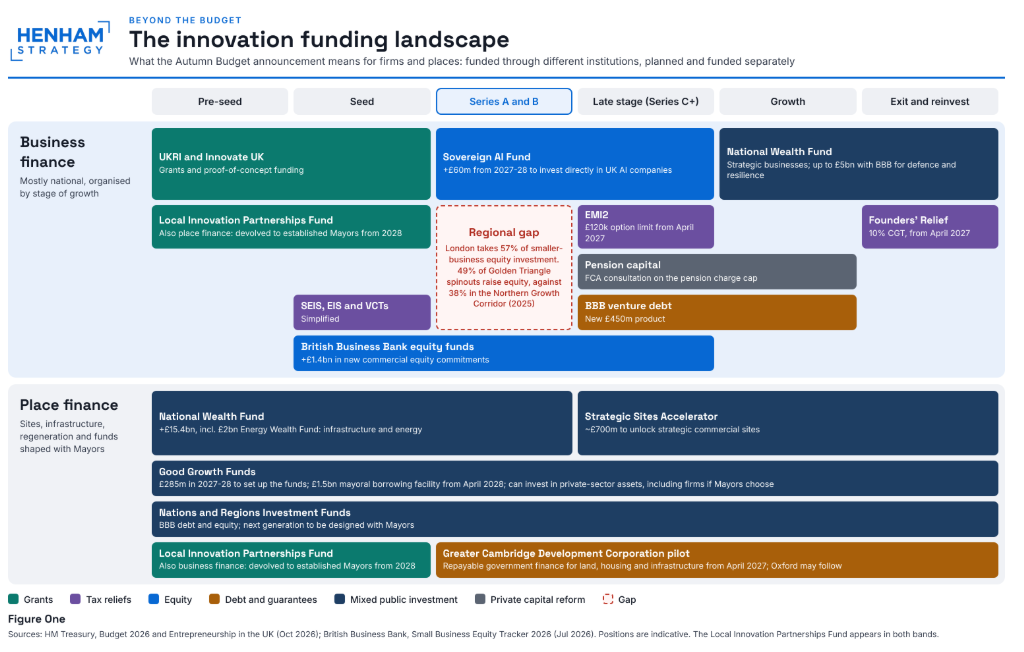
Figure 1 maps the Government's interventions against the financing needs of businesses at different stages of growth. From UKRI and Innovate UK grants and venture capital tax schemes to pension capital, venture debt and incentives for founders to stay and reinvest, the Government has covered a lot of ground.
Whether it will be enough remains to be seen, but one gap stands out: the middle.
Series A and B funding rounds are typically used to scale operations, attract strategic partners and expand into new markets. Yet, despite their importance to business growth, there appears to be relatively few targeted interventions in the Government's current funding offer to address this financing gap.
For a government promising ‘growth in every postcode’, there is an even bigger gap.
According to the Royal Academy of Engineering's Spotlight on Spinouts 2026, funding rounds up to Series A outside the Golden Triangle are around five times smaller than those within it, while just three Series B rounds have taken place outside the area since 2020, compared with 41 inside. Meanwhile, Barclays Eagle Labs and Beauhurst estimate that around 4,600 high-growth firms outside London have yet to secure a second equity round within the typical timeframe, a figure that could rise to 8,300 by 2035.
The additional £1.4 billion for British Business Bank equity funds and a new generation of Nations and Regions Investment Funds could help close this gap. But with the current Northern Powerhouse Fund largely focused on earlier-stage finance, it remains unclear whether their successors will be designed to address the more substantial funding needs of scaling businesses.
However, perhaps the bigger issue is not whether Government is filling the financing gaps, but who controls the funding. Business finance remains largely nationally directed, and beyond Local Innovation Partnerships Fund, MSAs have relatively little control over the capital available to businesses in their regions.
The Government has committed to co-designing regional funds with Mayors, but a seat at the table is not the same as control over where the money goes. Greater business rates retentions offer places more financial autonomy but, for now, the priority is to build a clear understanding of local businesses' financing needs and use that evidence to shape regional funds around them.
However, the success of these funds will ultimately depend on more than their design. Regions also need investment-ready businesses capable of accessing the capital, and the conditions for those businesses to grow.
Beyond the Capital Gap
To make good on Government funding, and to crowd in private capital, places need investment-ready businesses, and securing seed funding is very different from convincing investors of a firm's potential to scale.
The good news is that Mayors have greater influence over a useful lever: business support. As devolution and Local Government Reorganisation (LGR) reshape local delivery arrangements, MSAs are rethinking their business support offers. This presents an opportunity to go beyond helping businesses find finance to helping them become investment ready. This will be a bit of a shift, the Government's own evaluation of Growth Hubs highlighted their main role in finance as signposting businesses to financial support. But as MSAs redesign their offers, there is an opportunity to make investment readiness a more deliberate part of supporting businesses to scale.
However, as Figure 1 shows, the Budget and Government's approach to investment still largely separates businesses from the places in which they operate. The British Business Bank focuses on financing firms, while the National Wealth Fund, Strategic Sites Accelerator and Good Growth Funds support investment in sites, infrastructure and regeneration.
A series of research reports produced by Henham Strategy for Pioneer Group and The Crown Estate shows just how problematic this can be. Take real estate: innovative businesses need space to grow, and developers need demand to justify building - new laboratory space can cost at least £650 per square foot to develop, usually requiring rents above £60 to generate a viable return.
With responsibilities divided between Whitehall and regional authorities, coordinating these investments is no simple task. Laboratories can take three to five years to deliver, so without better alignment, more capital for businesses could simply shift the bottleneck from finance to infrastructure. Similar risks arise where investment in skills, business support, energy and transport fails to keep pace with business growth.
This is where devolution has an opportunity to make a difference.
MSAs are taking on greater responsibility for these agendas, yet they are still too often developed in isolation, shaped by different objectives and funding arrangements. While the Local Innovation Partnerships Fund offers a glimpse of a more joined-up approach, the standard approach to economic development is driven more by the programmes available than by what businesses need to grow.
Without better coordination, places risk funding firms with nowhere to grow, building space with no one to fill it, and developing skills for jobs that never arrive. Another argument for better connectivity between places!
The Decisions Still to Come
The Budget has put considerable money behind the Government's innovation ambitions, but questions remain about how achievable they are. If the Government is serious about delivering ‘growth in every postcode’, it may need to rethink some of its promises and focus instead on addressing the gaps in the current system and making its different interventions work better together.
After all, investment isn't just about major projects, but businesses too. And if innovation is to unlock growth across the UK, a less siloed approach to investment will be essential. Whether that comes from MSAs taking a more joined-up approach to their investment strategies, or Government giving places greater control over business finance, the way investment is planned, funded and delivered needs to change.
At a minimum, delivering on the Government's innovation ambitions requires answers to three key questions:
1. Where should innovation funding be prioritised?
2. Can regional funds close the scale-up financing gap, and how can MSAs better support businesses to access and leverage investment?
3. How can Government and MSAs move beyond siloed investment decisions towards a more joined-up approach that creates the conditions for business growth?
Ultimately, the real test of success is not whether every region can claim a globally significant cluster, but whether a business founded in Bristol, Belfast or Bradford can access the finance, space and support it needs to scale close to home.

Get in touch
We would love to hear from you. Get in touch at contact@henhamstrategy.co.uk, or through our contact page.

